
HealthTech Is Maturing: The Technology Is Ready,the System Isn’t
Key takeaways from HealthTech Global Summit
There’s a clear shift underway in healthtech. In Basel, thetone moved away from ambition and toward reality. The central question wasn’twhat technology could do—but why, despite everything now available, somuch of it still hasn’t been implemented.
Healthtech is no longer a story about possibility. It’sbecoming a test of execution.
The bottleneck is no longer technology
Not long ago, the biggest constraints were technical—limiteddatasets, underdeveloped AI models, and infrastructure that simply wasn’tready. Today, that picture looks very different. The tools are here, the modelswork, and the data layer is expanding rapidly.
Yet the system continues to lag behind.
The friction has shifted into the structure of healthcareitself: slow decision-making, fragmented accountability, and incentives thatdon’t always reward innovation. In practice, this means the challenge is nolonger building solutions—but getting them adopted.
Continuous care is accepted in theory, resisted inpractice
The idea of moving beyond reactive, episodic care is nolonger controversial. Continuous, predictive care has become the industry’sdefault direction. And in many ways, it is already technically feasible.
But healthcare systems are not designed to operate this way.
They still rely on point-in-time interactions, siloeddatasets, and reimbursement models tied to interventions rather thanprevention. Bridging that gap requires more than better tools—it demandsstructural change, which is inherently slower and more complex.
Prediction before symptoms changes the economics
One of the most meaningful shifts discussed in Basel is thegrowing ability to detect disease before symptoms appear. This isn’t a distantvision anymore—it’s becoming technically and clinically viable.
By integrating clinical records with genomics, lifestyledata, and environmental signals, healthcare can move intervention significantlyearlier. The implications are not incremental—they are systemic. Costs can bereduced, outcomes improved, and entire care pathways redesigned.
From an investment perspective, this is where long-termvalue is likely to concentrate. Not in treating disease more efficiently, butin preventing it earlier.
AI is not the constraint—decision-making is
There is little doubt left about the capability of AI inhealthcare. The hesitation lies elsewhere.
Healthcare institutions operate within tightly regulated,risk-sensitive environments. Decisions are slower by design, and accountabilitystructures are not yet adapted to AI-driven systems. As a result, evenwell-validated technologies face long adoption cycles.
This creates a paradox: innovation is accelerating, butimplementation is not keeping pace.
The companies that succeed will be those that understand howto operate within this reality—combining technical excellence with regulatoryawareness and institutional fluency.
Data only matters if it drives action
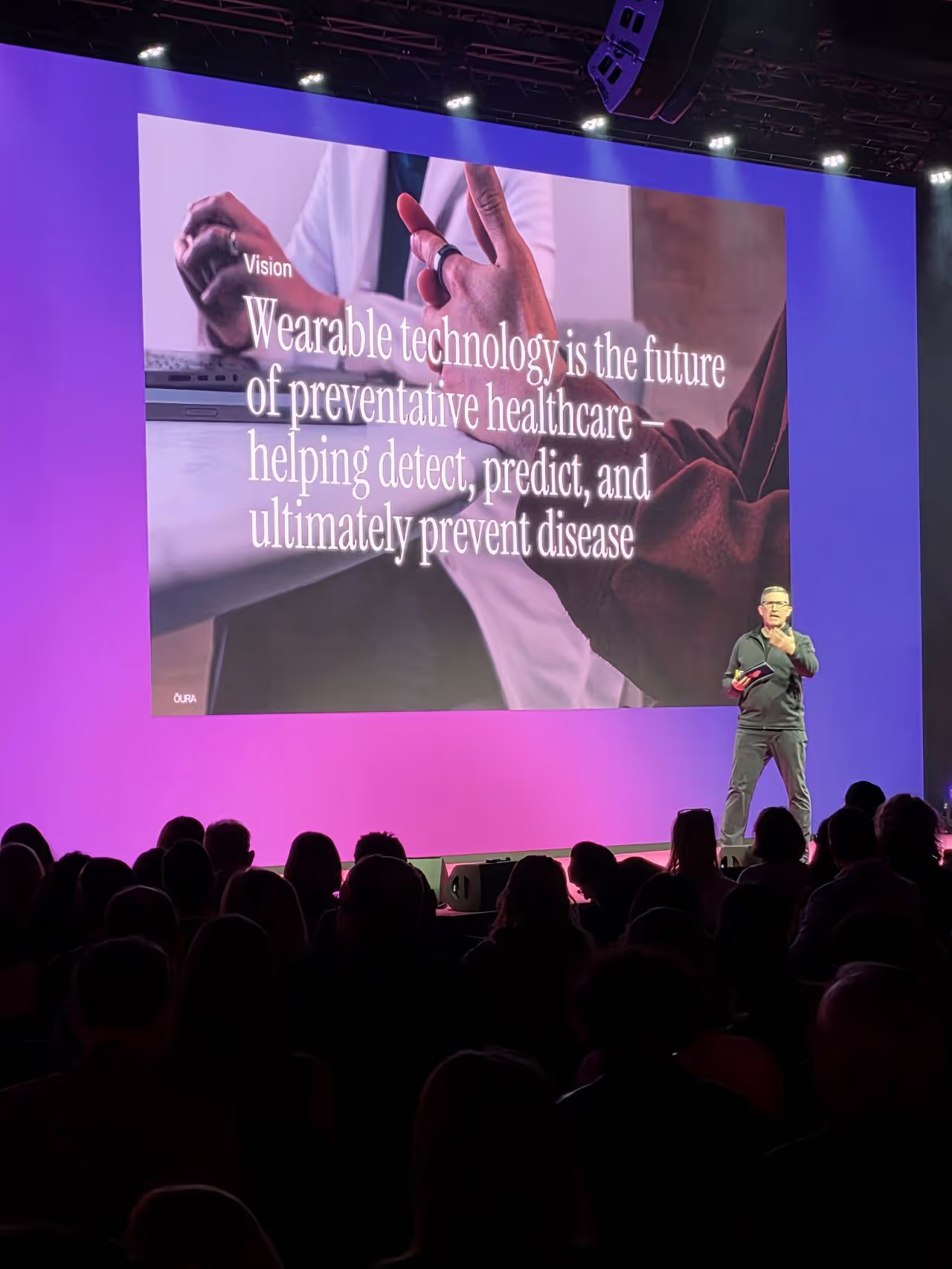
The past decade solved for data collection. Wearables,diagnostics, and remote monitoring tools have made it possible to track healthcontinuously and at scale.
But data alone does not change outcomes.
Patients don’t fundamentally alter behavior because ofdashboards, and clinicians won’t shift decisions unless insights are seamlesslyembedded into their workflow. The real challenge is not measurement—it’stranslation.
A useful way to frame this shift:
- from tracking ➡️ to decision support
- from insight ➡️ to intervention
- from data ➡️ to behavior change
That’s where the next layer of value is being built.
Hospitals are evolving into co-builders
Another important signal from the summit is the changingrole of hospitals. The traditional procurement model—slow, linear, andtransactional—is increasingly misaligned with the pace of innovation.
In its place, a more collaborative approach is emerging.Hospitals are beginning to work directly with technology providers, testingsolutions in real clinical environments and refining them iteratively.
This changes the nature of go-to-market strategies.Companies are no longer just vendors—they are becoming partners embedded in thedevelopment process.
Longevity is moving into the mainstream
Longevity has spent years on the edge of credibility, oftenassociated with hype rather than substance. That perception is beginning toshift.
The conversation is becoming more grounded, with a focus onextending healthspan, not just lifespan. This reframing aligns longevitymore closely with mainstream healthcare priorities and makes it easier to buildscalable, evidence-based models around it.
What was once a niche is starting to look like a realmarket.
Science remains the anchor
Amid rapid technological progress, one theme stood out forits consistency: the enduring importance of scientific rigor.
Healthcare does not move at the speed of hype cycles.Adoption is ultimately driven by evidence, validation, and trust. In thatsense, the fundamentals haven’t changed—even if the tools have.
For companies operating in this space, this is a reminderthat credibility is built over time, and shortcuts rarely scale.
What this means going forward
Healthtech is entering a more demanding phase. The narrativehas been established, the capital has been deployed, and the technology largelyexists.
What comes next is harder.
The market will increasingly differentiate between companiesthat can:
· integrate into real healthcare systems
· navigate regulatory and institutional complexity
· drive measurable impact
…and those that cannot.
Aegis Capital perspective
From our perspective, the most compelling opportunities sitat the intersection of technology and implementation.
We are particularly focused on areas where:
➡️prediction replaces late-stage treatment
➡️data becomes part of clinical workflow
➡️products influence real decisions and behaviors
Healthtech doesn’t need more ideas. It needs execution at system scale.
That’s where the next generation of category leaders willemerge.
